

[This is an update of a piece — “The Google Ads Tourist Tax” — I wrote in 2010. We had reprinted it here, fortunately, as ClickZ has disappeared most of its old content.]
Google runs a profitable amusement park, aimed specifically at new advertisers.
Punch in some of your wittiest naming suggestions to have AI sort through them, if you like. Or just flip a coin between these two offerings: “Six Red Flags,” or “Canada’s Blunderland.”
Is this amusement park profitable for the advertiser?
No, silly! It’s set up to make Google nontrivial sums of money!
Where we were in 2010
Let’s review some of the forces that led to budget drain on new advertisers back in the day, leading to many of them spinning out of the auction after giving up, but not before handing Google a profit premium for 30-90 days. This “revolving door” (churn) could have hurt Google, so they found ways to make it help them instead.
There were several drivers of these initially higher prices for new advertisers:
- Lack of Quality Score history. Without any statistical confidence, Quality Scores would start off lower. Since these, along with Max Bid, determined Ad Rank, all else being equal, new advertisers’ CPC’s would start out higher.
- Setup confusion. Back then, keyword campaigns defaulted to including the Content Network (aka GDN), using keywords as contextual triggers to show your ads broadly across the Web, not just on Google Search.
- Broad match without knowing. Newbies didn’t understand keyword match types and didn’t know how to look at the query reports to see all the inappropriate matches.
- Poor landing page choices, poor account structure. At the time, granularity was one of the secrets to successful Google AdWords campaigns. A lack of it came with a double whammy: poor conversion rates and lower Quality Scores (because user satisfaction was important to Google).
All these rookie mistakes led to failed ad campaigns, but during the time they were failing, the advertiser was paying a premium for each and every interaction. And of course, the presence of a revolving door of clumsy advertisers never makes it easy for the other participants in the auction. A clogged auction costs everyone.
Google ‘tax policy’ in a PMax world gone mad
Also back in the day, I dubbed Google “The Guvernment.” I mean, an entity that seems to control everything, has a seemingly endless list of rules and strictures, and even has the power to tax you… hey, if the shoe fits…
There are a whole bunch of apparent changes in Google’s world, and some very real ones, today. New campaign types like AI Max, relatively new ones like Demand Gen, etc. Consumers are searching much differently, using AI. Advertisers have FOMO. Google (as ever, when you’re the Guvernment) needs money to remain in charge.
Let’s focus on the granddaddy of all tax collectors today for big G: Performance Max.
In this amusement park, which is itself a merry-go-round of new and failing advertisers, there are many featured rides and diversions: Whack-a-Mole, a hall of mirrors, a vintage home game of Plinko, etc.
Please don’t go looking for the talented acrobats. This isn’t a three-ring circus!
Performance Max bundles Search, YouTube, Display, Discover, and Maps into one single machine-learning funnel. (And don’t forget that Gmail display ads are a featured subset of Display here.) For a new advertiser, it looks like magic: you upload a few images, type some headlines, and hit launch.
Transparency has improved recently. The Search Terms report is available, although many search terms are not shown and bundled under “other.” The Channel Performance report (screenshot below) is a “flowy,” “vibe reporting” sort of trip (I might’ve failed to mention the retail outlet selling edibles at this amusement park) that gets you a general sense that omnichannel is sort of happening.
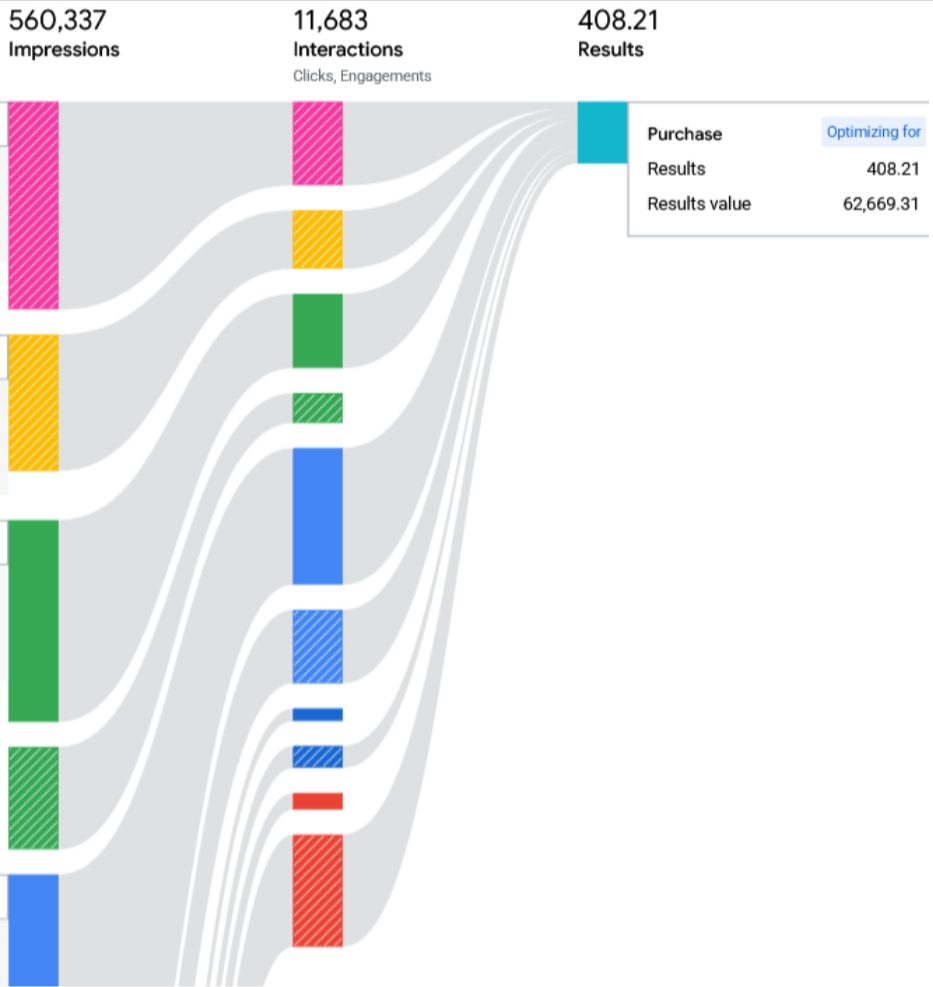
Experienced advertisers know enough to simply scroll down below the flowy stuff to see the full metrics for each channel and sub-channel. The “tourists” are already thinking about checking in for their return flight the hell out of there.
Another reason new advertisers might not delve as much into the inner workings of Performance Max is that years of PMax propaganda has warned them not to delve. “Let the algorithm do its thing.” It’s appealing to believe that, but. Knowledge is power.
From our standpoint, we do what we’ve always done, albeit amid changing platform features, AI advantages and disadvantages, and ever-evolving consumer landscapes. We delve.
So anyway, here are a few sources of high costs for new advertisers associated with the latest version of the Google Ads Tourist Tax, with specific reference to Performance Max:
- Never having run or conceptualized ad campaign formats that aren’t Performance Max. It’s a world where keywords are mere “signals.” Where audiences are “helpful suggestions.” Where overspending on your brand terms and first-party audiences is considered by Google to be a feature, not a bug. Where you don’t know how to force your ad allocation into or out of YouTube, Gmail, and GDN.
- Early lack of Quality Score history is still a thing. While campaigns are establishing traction, poor Quality Core will result in higher costs per interaction (often for less relevant inventory for your business).
- Add to that, of course, it’s going to take some time – maybe even a long time – for Smart Bidding algorithms to dial into the target (such as CPA or ROAS), especially when volume is lower.
- There is no manual bid option, and some advertisers actually take the bait to use “Maximize Clicks” as the bid strategy (indefinitely).
- Bleed to, for example, GDN, might be minor or it might be more than the advertiser bargained for. Reporting on placements so an advertisers can assess quality and performance is (no doubt deliberately) obscure.
- When it comes to YouTube inventory the new advertiser wasn’t going to explore anyway for at least a year: it might not be all that much. But Google is, of course, happy to sell you “just a little bit.” Put all those “little bits” together, and that unlocks a (warning: technical term) whackload of new revenue for Google from what some analysts (me, right now) estimate as “infinite” advertising inventory. From what we’ve observed, without careful monitoring, and until such time as (going largely on faith here) the algorithm has fully trained itself to seek out profitable intent across the full Google O&O funnel, Google wins at any price level. They’ll sell you huge numbers of low-cost impressions or clicks in YouTube. Or they’ll sell you some slightly more credible impressions or clicks in YouTube, for unreasonably high CPM’s and CPC’s. It’s not all worthless, and the reach is fantastic. But for the new advertiser, it’s another source of underperformance.
Experienced advertisers today aren’t so different from those in 2010. They know the road is long. They go looking for full reporting and are on the lookout for “gotchas.” They don’t confuse labels and PR for the actual inner workings of ad campaigns and user journeys.
Feeling taxed to death? If you’re a new advertiser, it’s the norm. Fortunately, the problem can be overcome with patience, optimization, and skilful execution.
In case you didn’t get the memo, then: the proverb is true – if you’re a newbie advertiser roaming Bambi-like into this realm. Nothing in this world can be certain, except death, and Google.
Like how we think? Need a great agency to execute on your Google Ads marketing objectives? Reach out!