
When you’re the size of Google, growth is hard.
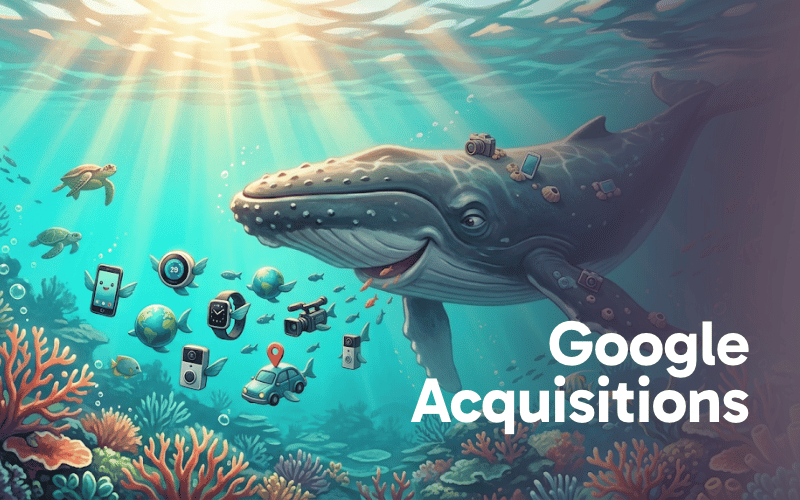
A good chunk of Google’s growth has been spurred on via acquisition. Some of the pivotal acquisitions and investments in its history have been:
- Applied Semantics (2003). This folded into the Google Display Network ad matching technology, AdSense.
- Keyhole (2004). Keyhole was integral to the development of Google Maps.
- Android (2005). Now the world’s most popular phone OS!
- Urchin (2005). Became Google Analytics, a near-monopoly on website analytics for anything short of costly enterprise products.
- YouTube (2006). You know it.
- DoubleClick (2007). Was the entrenched ad-serving leader and became the backbone of Google’s ad-tech stack.
- AdMob (2009). Gave Google the lead in in-app advertising.
- Motorola (2012), for patents and to kill it.
- Waze (2013). A revolutionary in-car navigation system that eventually came to power Android Auto’s unique navigation approach.
- Nest (2014). The humble thermostat. Massively popular in-home automation. Also cameras, doorbells, and wifi routers.
- Looker (2019), one I’m not fussy about (but admittedly, use the product). A data analysis and visualization tool.
- Fitbit (2021). You know it. Google will continue to develop Pixel products here.
- Anthropic (roughly a 14% stake). IPO’d today. Claude Code, et al.
- Other bets, including a controlling stake in Waymo (which is currently bleeding cash). You know that one.
- Google Ventures (GV) has also invested in and cashed out of massive tech startup success stories like Stripe, Slack, Docusign, and Uber.
(Applied Semantics is a personal favorite of mine, having spoken directly with the founders and having written about their technology before it was acquired to underpin AdSense/GDN.)
Wow, right?
Not a bad lineup
Android, YouTube, Google Maps, Google Analytics, Fitbit, Nest, and even Claude and Waymo, are by any objective measure, major household names. Not a bad lineup.
A lot of these eventually earth-shaking acquisitions happened fairly long ago, though.
One might be forgiven for assuming that Google has gone into a bit of a defensive shell on the M&A front, possibly because it’s gun-shy about regulators, antitrust, etc.
But of course, many of these lines of business are massive and still playing out.
Indeed, when you look at the above, (1) you underestimate Google at your peril, and (2) it’s plain that Google still commands and seeks consumer ubiquity and is not disproportionately leaning on revenue growth in its enterprise-facing businesses.
Robot pets, anyone?
So, what’s on the horizon for Google on the M&A front? Probably more of the Other Bets style investing, as opposed to thunderous acquisitions that break new technological ground, or high-ticket bolt-on acquisitions. If anything major comes along, we might not even know it (it’s hard to tell a Keyhole, a Waze, or an Android from a Blogger or a Feedburner out of the gate) at first.
If something obviously big transpires, then, it’s safe to say we’ll be caught a bit off guard.
If I had to guess, further consumer growth would rely on even more evolution in physical devices. Google is seen to soft-pedal the Pixel phone per se, but I happen to think it’s massively important. And I think other moves towards ubiquity (obviously with Android Auto, Google needn’t do anything with hardware), such as Nest, wearables, and other stuff I’m not thinking of because it hasn’t been thought of yet (robot pets?), will remain a big part of Google’s expansion push. But given how much is already in the Google fold, splashy acquisitions (or even sneaky ones) might not be part of the roadmap near term.
In the meantime, with a growing legion of skeptics, it’s even safer to say the naysayers will be unnerved by Google’s uncanny growth, when you line all the numbers up at the end of each fiscal.
We’ve come a long way from “PageRank,” or for that matter, “don’t be evil.”
A long, long way.
Now, I’d better check my Google calendar, confirm that my Google Meet call on Monday is still a “go,” and shoot off a few emails and documents in Google Workspace. 😁Then, I’ll head home from the office, with Android Auto mapping the bad news of the “10-minute slowdown” on the Gardiner Expressway (“but you’re still on the fastest route”).
[Some research for this piece was assisted by Gemini.]